Treatment plans with goals a reviewer can measure.
An individualized treatment plan organized by the six dimensions, with measurable objectives, interventions, frequency, responsible staff, and review dates, plus a worked example.
Progress notes are judged against the treatment plan. When the plan's goals are vague, every note that follows is hard to defend, because there is nothing measurable for it to show progress toward.
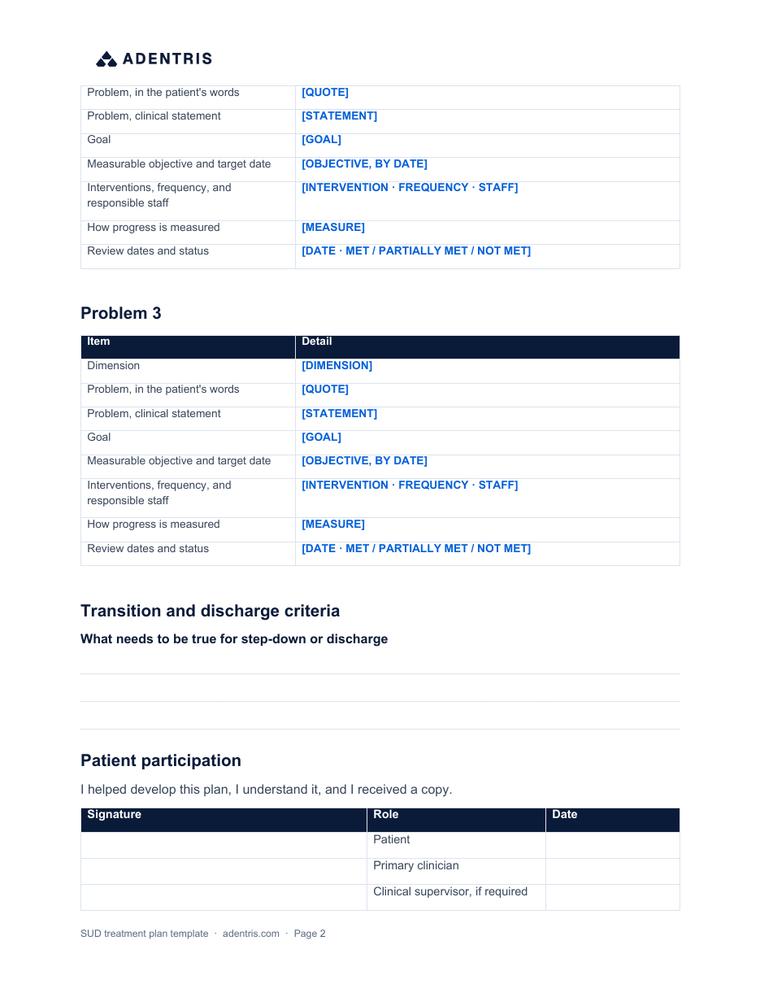
This template asks for the pieces payers look for: the problem in the patient's words and in clinical terms, a goal, a measurable objective with a target date, the interventions with frequency and responsible staff, how progress is measured, and the review dates. A worked example shows the level of detail.
What is inside
- Plan header with level of care, diagnoses, and review due date
- A worked example problem showing the expected level of detail
- Three problem blocks with goal, objective, interventions, measure, and review status
- Transition and discharge criteria
- Patient participation statement and signature block
Every problem, measurable.
Each problem block
- ProblemIn the patient's words and as a clinical statement
- GoalWhat the patient is working toward
- ObjectiveMeasurable, with a target date
- InterventionsType, frequency, and responsible staff
- ReviewDates and status: met, partially met, not met
Built for the people who work the denials.
- Primary clinicians and counselors writing treatment plans
- Clinical supervisors reviewing plans
- Utilization review staff who rely on plans for continued stay
Related on this site: Documentation Compliance, Documentation co-pilot.
Download the Word fileCatch these before the claim goes out.
Adentris reviews charts and claims against payer rules before submission, so missing documentation, modifiers, and authorizations surface while they can still be fixed.